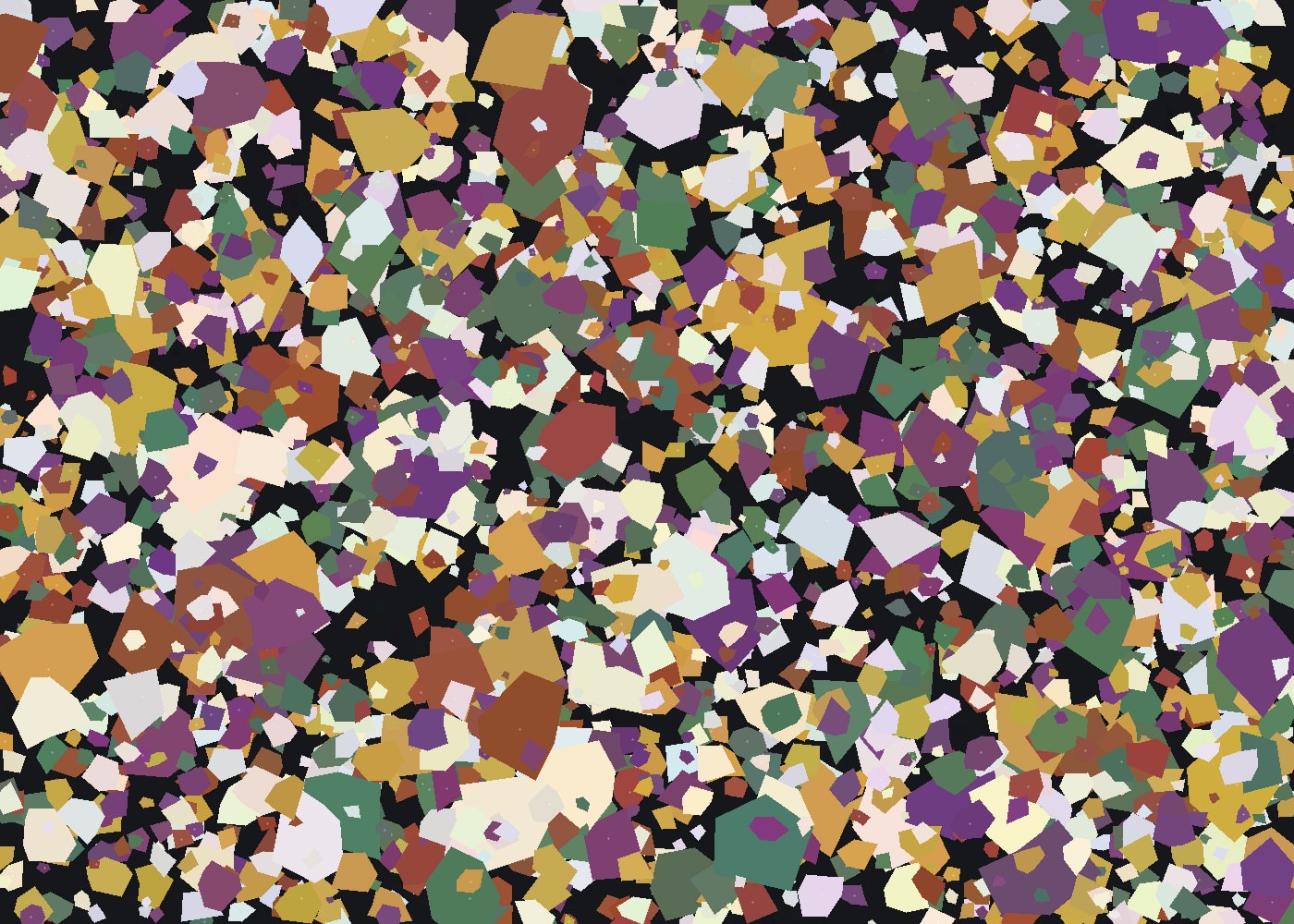
Aggregate is the vocabulary of terrazzo. The chips you select decide its colour, light and soul. A guide to the four families and how to compose with them.
If the binder is the grammar of terrazzo, the aggregate is its vocabulary. Every decision about character, from a serene marble whisper to a glittering glass statement, is made by selecting and proportioning the chips suspended within. Understanding the four principal aggregate families is the first step toward composing terrazzo with intent rather than chance.
Marble is the original terrazzo aggregate and remains the most refined. Quarried in an immense range of colours and ground to graded chip sizes, it offers soft, natural veining and a register that reads instantly as heritage and calm. Marble chips suit both fine, uniform speckle and the bold, large-format slabs of a Palladiana pattern. Their one caution is hardness; marble is relatively soft and slightly reactive to acids, so it favours interiors and gentle care over harsh commercial chemistry.
Where marble is soft, quartz is hard, bright and exceptionally durable. Quartz and granite aggregates resist abrasion and acids better than marble, making them well suited to high-traffic and more demanding environments. Their crystalline faces catch light crisply, lending a cleaner, more contemporary sparkle. For floors that must endure heavy use without losing their finish, quartz is often the quiet workhorse beneath a beautiful surface.
Choose marble for warmth and tradition, quartz for resilience, glass for colour and conscience, mother-of-pearl for the final, luminous flourish.
Recycled glass has transformed the terrazzo palette. Because it is manufactured, it comes in colours nature never offers, deep cobalt, emerald, amber and pure mirror, and it reads at full saturation in a neutral epoxy matrix. Crucially, much of it is post-consumer recycled glass, which means dramatic colour and a genuine sustainability story in one chip. A few considerations guide its use:
Mother-of-pearl, or nacre, is the connoisseur's aggregate. Iridescent and shifting, it does not sit still under light but shimmers as the viewer moves, lending a quiet, jewel-like luxury. It is rarely used as a primary aggregate; instead, a measured scatter among marble or glass elevates an entire surface, catching the eye without shouting. In hospitality and residential commissions it is the detail that registers as bespoke, the proof that a surface was composed rather than ordered.
The art lies not in any single chip but in the proportion of all of them. Chip size governs scale; fine aggregate gives a smooth, almost solid read from a distance, while larger chips create rhythm and movement. Colour ratio governs mood; a single dominant tone reads as restraint, a balanced multi-colour blend as energy. And the matrix colour, whether the resin is white, charcoal or tinted, changes how every chip behaves. At Deco Interior we develop samples for each commission, grinding and polishing trial blends until the surface speaks in exactly the voice the architecture intends. Aggregate, in the end, is not a finish chosen from a chart; it is a composition.
Both deliver the unmistakable speckled beauty of terrazzo, yet they behave very differently underfoot, in colour and over decades. A clear-eyed comparison for specifiers.
Read article→
Both deliver a continuous, joint-free surface, yet they speak in different voices. Knowing where each excels is the key to specifying with conviction rather than compromise.
Read article→Both deliver the unmistakable speckled beauty of terrazzo, yet they behave very differently underfoot, in colour and over decades. A clear-eyed comparison for specifiers.
Read article→