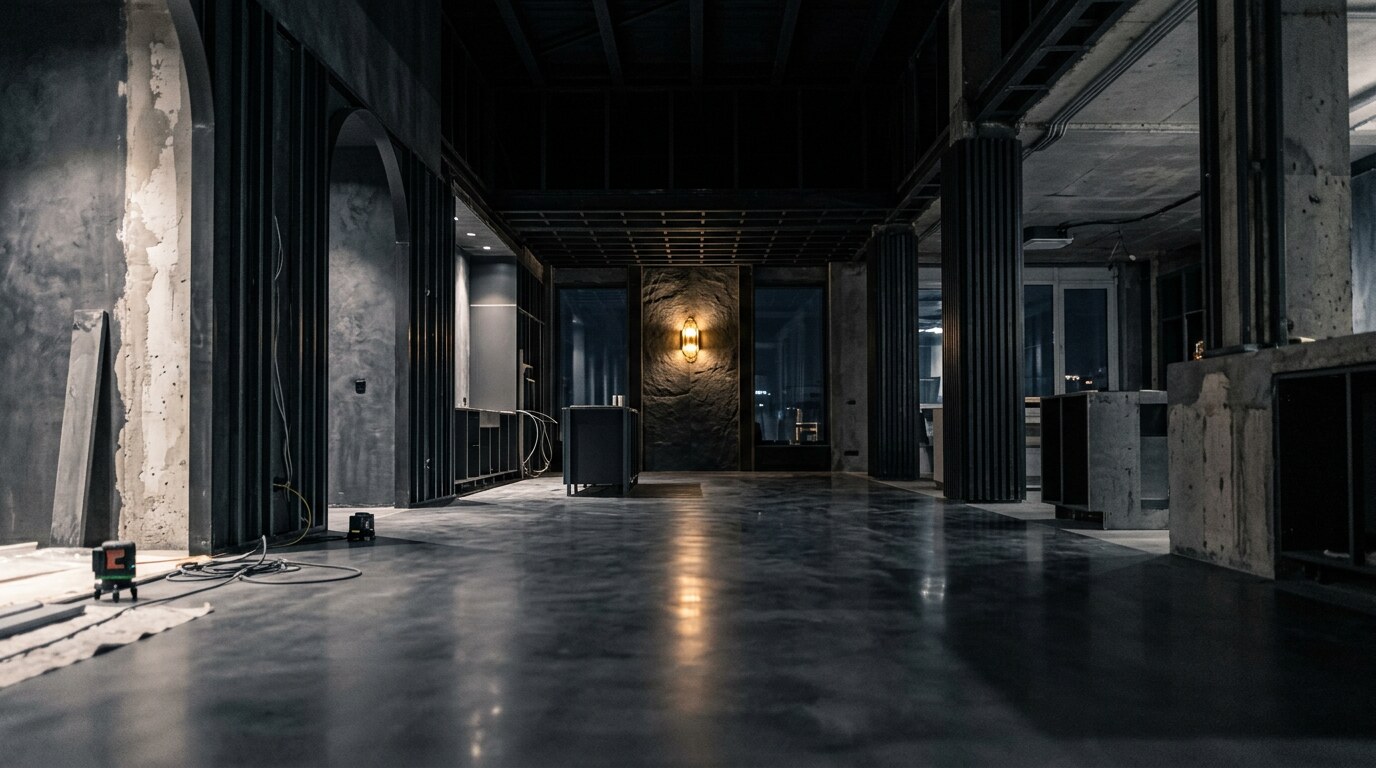
Both deliver the unmistakable speckled beauty of terrazzo, yet they behave very differently underfoot, in colour and over decades. A clear-eyed comparison for specifiers.
Terrazzo is not a single material but a method: aggregate suspended in a binder, ground and polished to reveal a continuous, jewel-like surface. The character of any terrazzo is decided long before the first chip is poured, by the binder you choose. Today that choice almost always comes down to two systems, cement and epoxy resin, and the difference is far more than chemistry.
Cement terrazzo is the historic form, a cementitious matrix that has paved Venetian palazzi and civic halls for centuries. It is mineral, breathable and deeply traditional. Epoxy terrazzo uses a two-component thermosetting resin, a base and a hardener that cure by chemical reaction rather than by drying. The resin matrix is far thinner, typically laid at around 9 to 12 millimetres against the 40 millimetres or more often required for a bonded cementitious bed.
That thinness is not a detail. It changes how the material loads a structure, how it bridges substrates, and how freely colour can be controlled.
Choose epoxy for colour, lightness and seamless interiors; choose cement for breathability, exterior durability and the gravity of tradition.
For specifiers, the conversation moves quickly to compliance. Slip resistance is expressed in R ratings, with R10 suitable for most dry interior circulation and R11 specified for wetter zones such as spa thresholds and pool surrounds, achieved by adjusting the final grind and finish. Precast terrazzo tiles and units are governed in Europe by EN 13748, which sets out requirements for both interior and exterior terrazzo elements. Epoxy systems bond chemically and are seamless, which makes them exceptionally hygienic and easy to maintain, a quality prized in laboratories, galleries and hospitality. Cement terrazzo, being mineral, manages moisture and temperature more like natural stone.
Both surfaces are extraordinarily durable when treated correctly. Epoxy resists most household chemicals and needs only periodic resealing of its surface; cement benefits from breathable penetrating sealers and a more mineral care regime. Neither should be cleaned with harsh acids. Properly maintained, either system will outlast most of the interiors built around it.
The honest answer is that there is no universally superior binder, only the correct one for a given brief. A pale, jointless gallery floor or a bespoke staircase in a saturated tone points decisively to epoxy. A breathable courtyard, a heritage restoration or an exterior terrace points to cement. At Deco Interior we begin every commission with the architecture, not the catalogue, then let the binder follow the intent of the space. The result is terrazzo that feels inevitable rather than applied.

Aggregate is the vocabulary of terrazzo. The chips you select decide its colour, light and soul. A guide to the four families and how to compose with them.
Read article→
Both deliver a continuous, joint-free surface, yet they speak in different voices. Knowing where each excels is the key to specifying with conviction rather than compromise.
Read article→
Once dismissed as institutional flooring, terrazzo has returned as a signature of considered luxury. We trace the revival and explain why designers cannot put it down.
Read article→