Terrazzo was born of Venetian thrift and refined over five centuries into an art. Understanding Venetian terrazzo and the Palladiana tradition explains why the material still feels both ancient and entirely contemporary.
Few materials carry their origins as legibly as terrazzo. Its name comes from the Italian terrazzo, a terrace, and its invention is usually placed in the Veneto of the fifteenth century, where mosaic and stone workers found a way to give a second life to the marble offcuts left over from grander commissions. What began as an act of thrift became, over five hundred years, one of the most refined flooring traditions in Europe — and the direct ancestor of the engineered terrazzo we fabricate today.
The classic Venetian floor, the terrazzo alla veneziana, was a labour of patience. Marble chips were spread into a lime-based binder over a prepared bed, compacted, and then ground by hand and later by machine through successively finer abrasives until a dense, glassy plane emerged. A final treatment with linseed oil and wax sealed and enriched the surface, giving those old Venetian floors their characteristic depth and soft sheen.
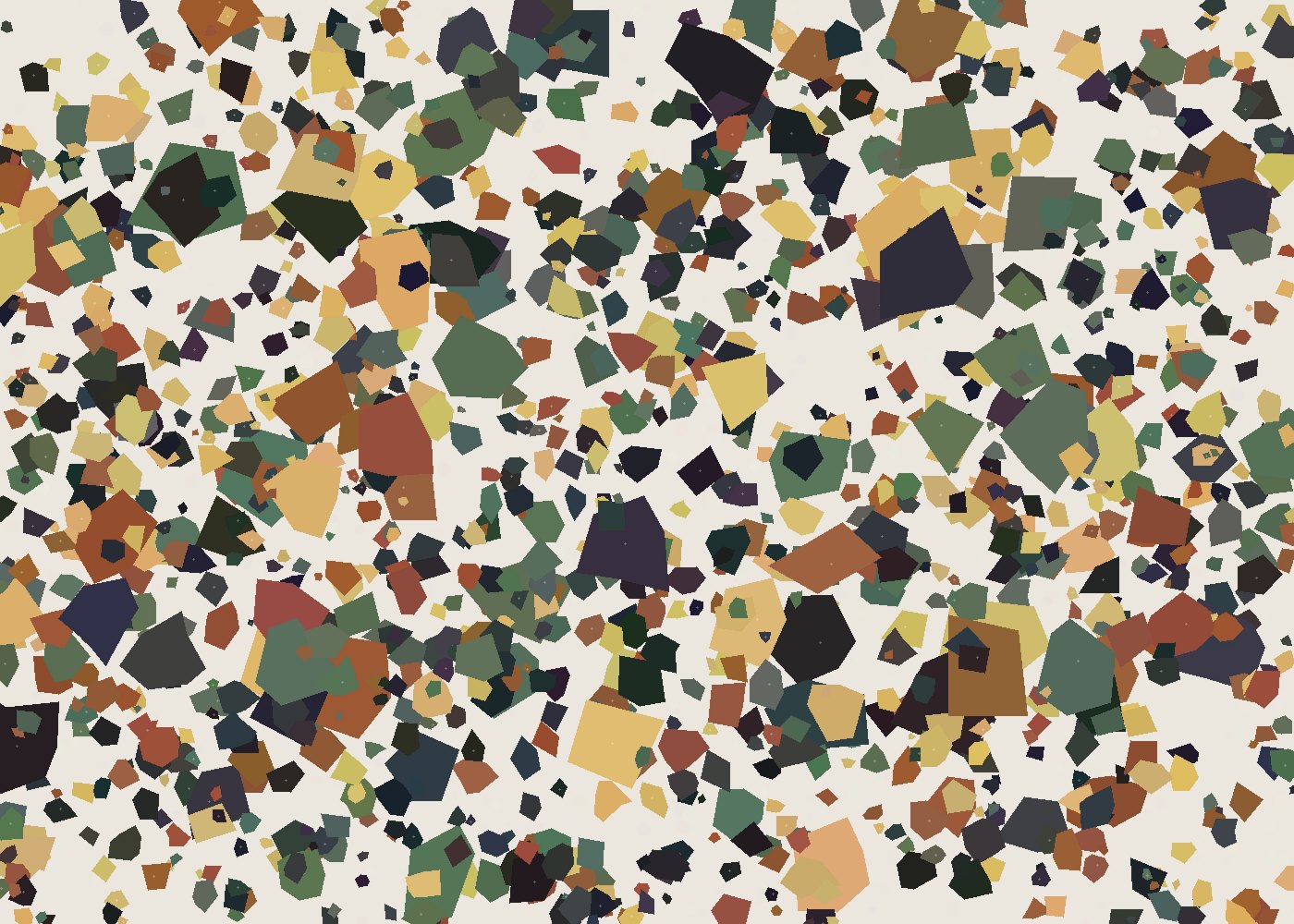
The genius of the method is that the floor is essentially a poured stone. There are no tiles and no grid; the surface is continuous, and the pattern is the aggregate itself, suspended like confetti in a calm field.
If fine-chip Venetian terrazzo is the material at its most serene, Palladiana is its most expressive register, named in the spirit of the architect Andrea Palladio. The Palladiana technique uses large, irregular slabs of marble — fractured plates rather than small chips — set with deliberate gaps between them. Those interstices are then filled with a contrasting fine terrazzo or coloured binder, so the eye reads a bold mosaic of stone islands held in a quieter sea.
Palladiana is terrazzo at architectural scale: each large chip is placed by hand, and the rhythm of plate, gap and fill turns a floor into a composed surface rather than a repeated one.
Because the large chips are hand-laid, no two Palladiana surfaces are identical. The fabricator controls the size range of the plates, the width of the joints and the colour of the matrix, and from those three decisions an enormous expressive range follows — from the grand, pale floors of Venetian palazzi to the graphic, high-contrast surfaces favoured in contemporary interiors.
The through-line from those Venetian floors to a modern prefabricated terrazzo slab is unbroken. The aggregates, the grinding sequence and the visual logic are inherited directly; what has changed is the binder and the control. Where the old masters relied on lime and time, contemporary fabrication can use a high-strength epoxy matrix, cast and cured under controlled conditions and then ground to a precise finish. This is the discipline behind the Italian engineered terrazzo we work with — the Veneto's craft, held to industrial tolerances.
This lineage is not mere romance; it is the reason terrazzo reads as it does. The material looks unforced because its pattern is genuinely random, the product of real stone broken and distributed rather than printed. It feels permanent because the technique was designed for permanence, to be ground back and re-polished rather than replaced. And it carries cultural weight — a Venetian floor is an argument that a surface can be both humble in origin and aristocratic in effect.
To specify terrazzo today is to draw on that five-century conversation. Whether the project calls for the calm of a fine Venetian field or the drama of a large-chip Palladiana, the heritage gives both a language and a guarantee — that what looks timeless was, in fact, made to last that long.
Both deliver the unmistakable speckled beauty of terrazzo, yet they behave very differently underfoot, in colour and over decades. A clear-eyed comparison for specifiers.
Read article→
Once dismissed as institutional flooring, terrazzo has returned as a signature of considered luxury. We trace the revival and explain why designers cannot put it down.
Read article→
A single terrazzo stair tread passes through a dozen disciplined hands before it reaches site. We open the workshop doors on the craft behind the finish.
Read article→