Beyond the floor, terrazzo has become a material for objects: kitchen countertops, vanities, tables and seating. At furniture scale, the same craft yields pieces that are seamless, sculptural and deeply personal.
Terrazzo earned its reputation underfoot, but some of its most compelling contemporary work happens at the scale of an object. A countertop, a vanity top, a dining table or a bench made in terrazzo carries all the depth and tactility of the floor tradition, concentrated into a piece you touch every day. At this scale the material stops being a surface you walk across and becomes a thing you live with — and that shift changes both what it can do and how it should be made.
A worktop is the perfect stage for terrazzo because it is small enough to show the aggregate in full, generous detail. On a floor the eye reads the field; on a countertop it reads individual chips, the way a particular marble catches light, the precise rhythm of a large-chip Palladiana. The material's strengths translate directly to furniture.
A kitchen or bathroom surface has to earn its keep. For countertops the binder choice leans toward epoxy terrazzo, whose dense, low-porosity matrix resists staining and moisture better than a more open cementitious mix, and which allows the slim, crisp edge profiles that a refined kitchen wants. The surface is honed or polished to taste and then sealed, and everyday care is straightforward.
A terrazzo countertop is not a slab of stone cut to fit a kitchen — it is a composition designed for that kitchen, in which the aggregate, the colour of the binder and the line of the edge are decided together with the rest of the room.
Practical detailing matters as much as the mix. Integrated or undermounted basins, drainage grooves, splashbacks formed as one with the top, and the treatment of heat and acids near a hob are all resolved in the design stage. Honed finishes are forgiving of fingerprints and water marks; high-polish finishes maximise the depth of the aggregate at the cost of showing more in daily use. The right choice is a conversation between the look the client wants and the way the surface will actually be lived with.
The same logic extends across a room. Vanity tops with integrated bowls give a bathroom a monolithic calm; consoles, side tables and dining tables become quiet centrepieces; even benches and seating can be cast, where weight and structure allow. Because each piece is made to order, dimensions, edge profiles and the aggregate mix can be matched to adjacent surfaces — a countertop and a floor cut from the same conceptual palette, or deliberately contrasted.
Commissioning terrazzo furniture is a design process, not a catalogue selection. We begin with samples — trial mixes that let the client see real aggregate in the real binder — because nothing on a screen conveys how a stone reads at arm's length. From there the conversation moves through form, edge and finish.
Made this way, a terrazzo object is genuinely singular. It carries a five-century craft into a piece scaled to the hand, composed for one room and one client, and built to be re-finished rather than replaced — a surface that becomes more clearly yours the longer you live with it.
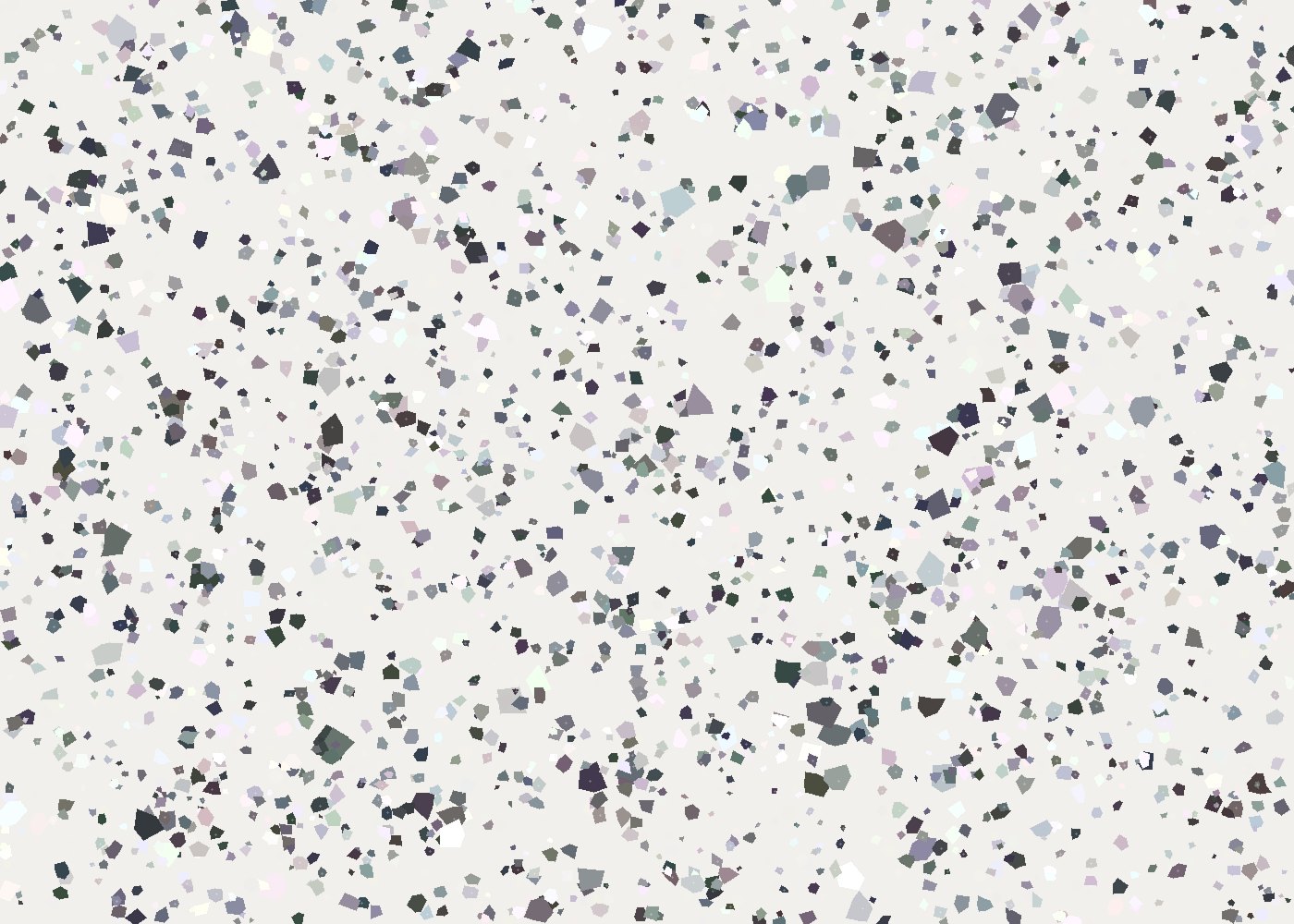
Once dismissed as institutional flooring, terrazzo has returned as a signature of considered luxury. We trace the revival and explain why designers cannot put it down.
Read article→
Hospitality asks a surface to be beautiful, durable, safe and endlessly walked upon. Terrazzo answers all four, which is why it has become the material of arrival.
Read article→
Colour in terrazzo is not painted on but cast through. Understanding how pigment, binder and aggregate conspire is the difference between a palette that pleases and one that endures.
Read article→